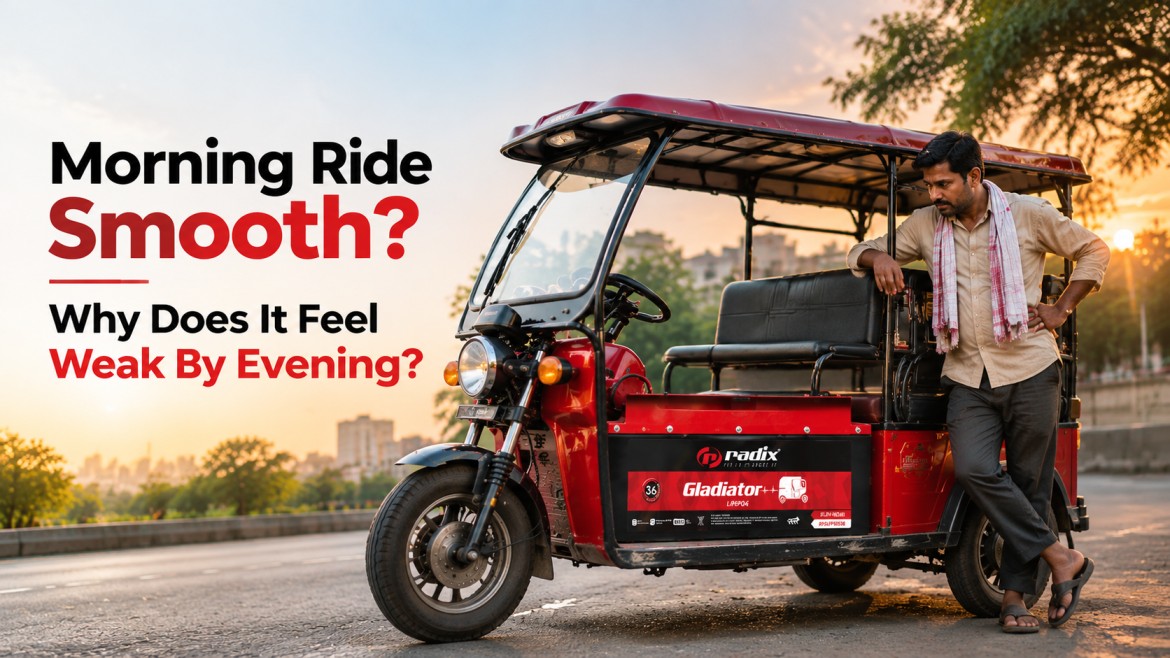
The e-rickshaw may seem to be fast and responsive in the morning, but it can be slow in the evening. It is not necessarily because of any problem with the battery. Most often, it is due to the fact that the battery has depleted a significant amount of energy after long hours of carrying passengers, traveling through traffic, accelerating, and adapting to different road surfaces. The E-Rickshaw Battery Manufacturer India should consider all these aspects and not just focus on the battery specifications.
For drivers, there is one straightforward question that needs an answer: “What is different from the morning drive to the evening drive?”
The Battery Starts The Day With More Energy
At the beginning of the day, the battery is typically charged to a relatively higher level. This ensures that there is sufficient power for accelerating, going up slopes, and accommodating passengers.
With each journey during the course of the day, there is usage of some of the energy stored in the battery. By the end of the day, although the battery might be able to support the vehicle movement, the amount of energy left is lower than when the work shift began.
This explains the variation in performance despite no immediate issue with the battery.
An E-Rickshaw Battery Manufacturer in India should point out the factors involved.
Passenger Weight Changes Energy Use
An empty and a loaded e-rickshaw do not put in the same demand on the motor.
More people on board means the motor has to work harder, especially when pulling away from rest or climbing up a hill. This extra effort over a period of time will drain the battery.
Suppose two drivers have similar e Rickshaws. One driver normally carries one or two passengers while the second driver always carries people in full numbers. Both have the same battery fitted in their e Rickshaws. The first driver covers more distance on a single charge than the second driver on a daily basis. Now, who has a better battery?
Stop-Start Traffic Uses More Energy
City driving can be slow, with frequent stops and starts.
Every time the vehicle is accelerated from a standing start, more power is demanded from the motor than when running at a constant speed. In heavy traffic, this can happen hundreds of times in a single journey.
It is a particular problem in busy markets and on short runs in the city, as is the case with many drivers in Meerut and other towns in Uttar Pradesh.
An E-Rickshaw Battery Company in Meerut that supplies batteries to local drivers should be aware that a battery that performs well in controlled conditions may find itself in very tough conditions in the real world.
Route Changes Can Affect The Evening Shift
Drivers seldomly repeat the same route throughout the day.
There might be short, low-intensity drives in the morning, followed by driving in more traffic, longer routes, or rougher roads later on.
These factors can increase the energy consumption of the vehicle.
Tyre pressure also plays an important role in the rolling resistance, which means that the motor needs to work harder and expend more energy when the pressure is low.
A drop in performance in the evening, therefore, should be evaluated with the whole route and state of the vehicle in mind.
Partial Charging Can Make The Next Shift Harder
Some drivers charge the vehicle for a short period of time between trips or during their lunch.
That extra charge can make all the difference, but a quick charge might not have enough time to replace all of the lost energy.
If the battery starts out the afternoon only partially charged, the evening shift will have less energy than the morning one. This becomes an even bigger issue if the pattern repeats itself over multiple days.
A responsible E-Rickshaw Battery Manufacturer in India would consider both how much the vehicle was driven and how much it was charged back up during the day.
The important question isn’t just “how much did the vehicle drive?”
but also “how much energy did the battery regain before being driven again?”
Driving Style Also Matters
Fast acceleration can drain more energy than slow acceleration.
Drivers who are racing against the clock may find themselves accelerating rapidly, braking, and accelerating again and again throughout the day.
A gentler approach to driving can conserve energy by using the battery more efficiently
and
taking away some of the wear and tear on the car’s systems.
It doesn’t mean that the driver has to be especially slow, only that they give the car a gentle kick rather than flooring it at every opportunity.
When Should The Battery Be Checked?
Some degree of evening sluggishness is to be expected as the battery discharges. However, if there is a sudden or significant change this should be investigated
Check the system if:
- The range is falling away sharply compared with previous days
- It is taking significantly longer to charge
- The battery is not reaching its normal fully charged voltage
- The vehicle is feeling sluggish even at the start of the day
- The charger is reporting multiple errors
- Connections are hot or loose
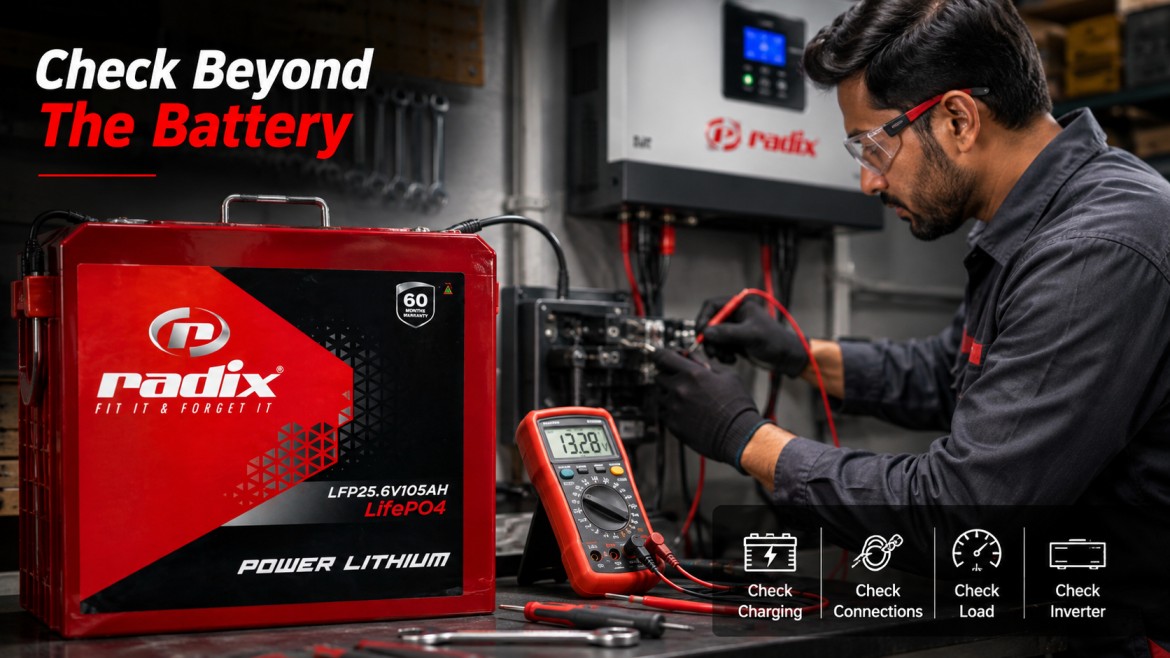
The problem could be with the battery, the charger, the wiring, the motor, the controller, the tyres, or the vehicle load. This is why diagnosis should always precede replacement.
Radix And Real E-Rickshaw Usage
The process of selecting batteries for e-rickshaws at Radix always considers the manner in which the vehicle operates.
The distance driven per day, the number of passengers, the time needed for recharging, and the traffic conditions are all variables.
As an E-Rickshaw Battery Manufacturer in India, we understand that the former is dependent on the conditions of the driver.
For an E-Rickshaw Battery Company in Meerut, understanding the conditions a driver operates in can be the most effective means of choosing an appropriate battery. A driver who operates in highly populated areas may have different requirements from a driver who operates under shorter distances and with fewer passengers.
Final Thoughts
An e-rickshaw may perform better on a daily basis since the battery is fully charged at the start of the day.
By the evening, the weight of the passengers, traffic, acceleration, detours, and limited opportunity to charge the battery may combine to reduce the range.
Before concluding that the battery is faulty, evaluate the cumulative effect of factors over an entire day.
The more consistent the battery performance is with the routes driven and the work patterns of the driver, the more predictable the range will be on a day-to-day basis.
Frequently Asked Questions
1. Why Does My E-Rickshaw Feel Slower In The Evening?
The battery has already used part of its stored energy. Heavy loads, traffic, repeated acceleration, and long routes can also increase energy use.
2. Does Passenger Weight Affect E-Rickshaw Battery Range?
Yes. A heavier vehicle needs more energy, especially during acceleration and uphill travel.
3. Can Traffic Reduce E-Rickshaw Range?
Yes. Frequent stopping and restarting can use more energy than steady-speed driving.
4. Does Partial Charging Help During The Day?
It can add useful energy, but a short charge may not fully restore what the battery used earlier.
5. When Should An E-Rickshaw Battery Be Checked?
Get it checked if range drops suddenly, charging changes, the vehicle feels weak from the morning, or the charger shows repeated problems.
6. Why Choose Radix As An E-Rickshaw Battery Manufacturer In India?
Radix focuses on matching battery solutions with real driving needs, including daily distance, passenger load, charging time, route, and local operating conditions.