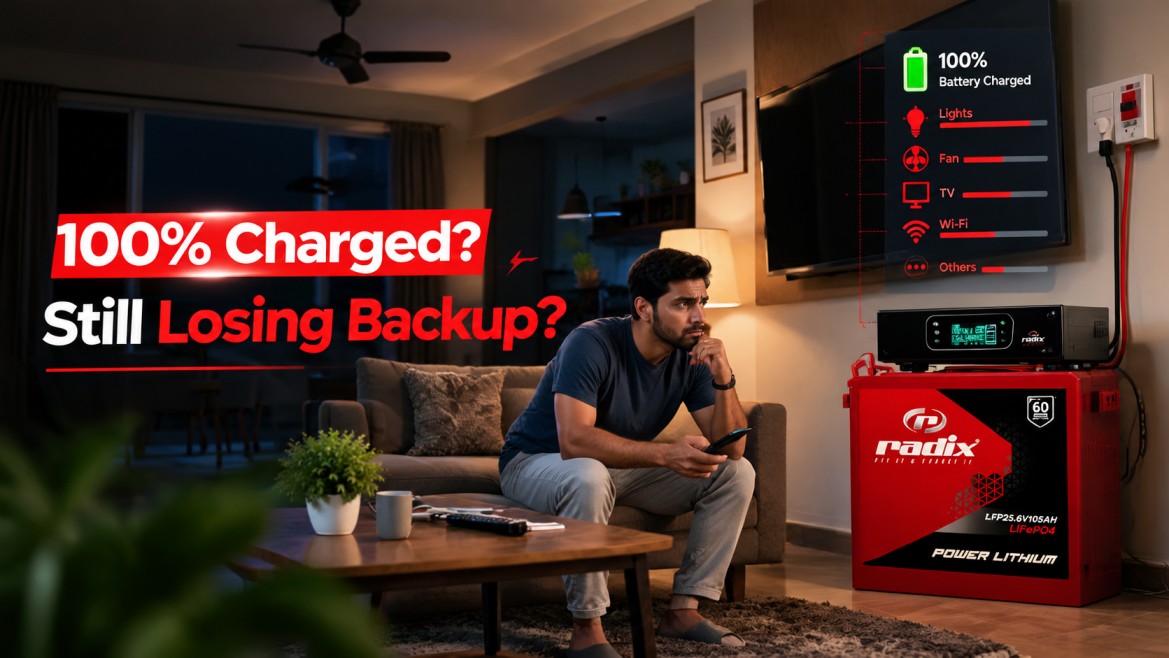
A battery may indicate a full charge, but it may offer lesser backup than expected. This does not necessarily mean that the charging indicator is faulty or the battery has failed all of a sudden. An experienced Inverter Battery Manufacturer in India would investigate the load, battery’s age, connections, inverter’s condition, and the pattern of the power-cut before concluding an issue.
In short, the full battery indicator only states the charge level of the battery; it does not indicate how fast your home will consume the electricity
Why A Full Charge Does Not Guarantee Long Backup
Battery backup depends on two factors; the amount of energy the battery can deliver and the rate at which the connected appliances consume.
Take for instance, a house that used to have two fans, three lights, and a Wi-Fi router hooked onto an inverter. As time goes, the owners buy a bigger television, CCTV cameras, laptops, more lights, and several phone chargers. The battery may reach the usual full mark, but the rate of energy consumption has increased, thereby draining the power faster than before.
This is one of the first problems an Inverter Battery Manufacturer in India will address if a customer complains of inadequate backup.
Before rushing to the battery’s assumption, cross-check the consumption load with what was connected to the inverter during installation.
Your Home Load May Be Higher Than You Think
Many appliances seem to be small when considered individually
A Wi-Fi router, CCTV, television, laptop, set-top box, and mobile chargers might not seem like much. However, when combined with a few fans and lights, the power they consume altogether can be pretty significant.
Hence, two homes using the same battery may have vastly different backups.
One family might be able to turn off a lot of high-drain appliances when the backup starts depleting, while the other might not. Obviously, the latter would have a faster-draining battery.
A good Inverter Battery Manufacturer UP would advise users based on their essential appliances and not the idea of having everything running.
Battery Age Changes Usable Capacity
A battery is not new forever.
As it goes through charge and discharge cycles, the ability to store power is changed. Even if the battery is fully charged, its capacity may be lower than on the first day.
Thus, if the battery has a certain amount of age on it, even if it reaches the charging limit, its capacity reserve may be lower than expected.
Other symptoms may also be present:
- Backup time decreases progressively over a period of months
- Charging occurs more rapidly than before
- Low battery warnings occur at higher charge levels
- There is increased sensitivity to heavy loads
The battery’s age should not be the sole determining factor for replacement, but should be taken into account with its backup, charge characteristics and physical condition.
Wiring Loss Can Quietly Reduce Backup
Sometimes the battery is good, but the power goes somewhere else.
Loose terminals, corroded connections, small cables or poor joints can lead to higher resistance in the circuit, resulting in voltage drops, heating or inefficient power delivery.
The system may still be functional, so it’s easy to overlook.
Before replacing a battery, check:
- Battery terminals
- Cable tightness
- Cable size
- Corrosion signs
- Heating near connections
- Inverter connections
An Inverter Battery Manufacturer in Meerut catering to residential and dealer customers in the region should always consider installation quality when diagnosing low backup issues.
A good battery will not compensate for a poor electrical connection.
The Inverter Also Uses Energy
The inverter is not 100% efficient.
While the power stored as DC current in the battery is converted to AC current for use by home appliances.
Some power is lost in the process.
The extent of loss depends on several factors like inverter design, load and others.
Also, an old or inappropriate inverter can have a negative impact on the ability of the battery to charge and discharge.
Thus, if the inverter is not operating at optimal load, one could be in for a sobering surprise when it comes to the backup provided by the inverter-battery combination.
That is why it is important to think of the battery and inverter as a system.
A responsible Inverter Battery Manufacturer in India will advise you on the appropriate pairing based on battery Ah, inverter capacity, the load that is likely to be connected and the desired back up.
Your Backup Expectation May Have Changed
Sometimes there is not a technical problem.
The demand may have changed.
A family once used to be happy with three hours of fans and lights, but now they want Wi-Fi, CCTV, television, laptops and other appliances to remain on as well.
The battery is being asked to do more than it used to.
It can make longer power cuts seem like the same thing. A short circuit system may seem insufficient if local outages begin to last two or three hours.
For users in Uttar Pradesh and cities such as Meerut, actual outage number and local use should be factored into battery planning. This is where working with Inverter Battery Manufacturer UP helps match the battery to real operating conditions and not a general capacity chart.
What Should You Check Before Replacing The Battery?
If, despite a fully charged battery, your backup fails you, the remedy does not necessarily lie in replacing the battery
First explore the entire setup
Ascertain that the load has not risen beyond the rated capacity. Check wiring and terminals, the age of your battery, if the inverter is charging the battery and most importantly, compare the load to which the inverter was subjected to with the power cut it was designed to overcome.
At Radix, we believe in going beyond the battery to determine an accurate solution for your backup woes. As an Inverter Battery Manufacturer in India, we have to consider more than just the battery to ensure that your backup works for you. Load, battery condition, charging, installation and usage patterns are all factored in
efore a solution is proposed. This way, we can ensure that your backup power source is not being undersized for your needs.
Final Thoughts
A fully charged battery might not give you as long of a backup as you expect, since full charge + available backup is not equal.
The higher the load, the more effect battery ageing, wiring loss, inverter efficiency, and longer mains outages will have on available backup time.
Before buying a bigger battery, find the cause of the reduced backup.
The solution may be a bigger battery, but might also include load management, wiring repair, inverter check, or better system sizing.
Frequently Asked Questions
1. Why Does My Fully Charged Inverter Battery Drain Quickly?
The connected load may be high, the battery may have lost usable capacity, or the wiring and inverter may be reducing system efficiency.
2. Does A Full Battery Always Mean Maximum Backup?
No. Full charge only shows the starting charge level. Actual backup depends on battery condition, load, inverter efficiency, and usage.
3. Can Old Wiring Reduce Inverter Battery Backup?
Yes. Loose or corroded connections can create voltage drop and power loss, which may reduce the backup you experience.
4. Should I Buy A Bigger Battery If Backup Is Low?
Not immediately. First check the load, battery health, inverter support, charging system, and wiring. A bigger battery will not fix every problem.
5. Why Choose An Inverter Battery Manufacturer In Meerut?
A local manufacturer or dealer can better understand regional power-cut patterns, usage conditions, service needs, and common inverter applications.
6. How Does Radix Help With Inverter Battery Selection?
Radix considers load, required backup time, inverter compatibility, charging conditions, installation, and real power-use patterns before recommending a suitable battery solution.