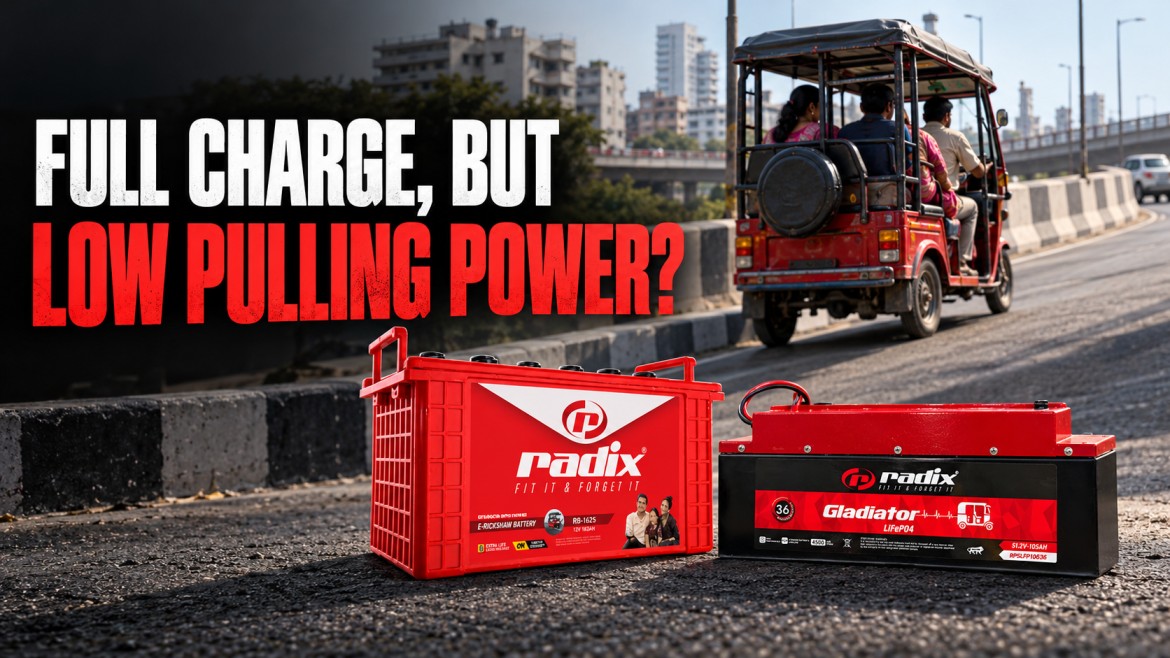
An E-Rickshaw battery manufacturer in India must understand how batteries perform under heavy loads. An e-rickshaw may run smoothly on flat roads but lose pulling power while climbing a flyover. This can happen even when the battery shows a full charge.
So, why does an e-rickshaw struggle on inclined roads?
The main reasons include battery voltage drop, heavy passenger loads, battery ageing, and electrical faults. These factors affect how much power reaches the motor. Understanding them can help drivers identify problems and improve daily vehicle performance.
Why Does an E-Rickshaw Need More Power on Inclined Roads?
An e-rickshaw needs more power when travelling uphill. On flat roads, the motor mainly works against tyre friction and air resistance.
However, inclined roads create an additional challenge. The motor must also overcome gravity to move the vehicle forward.
As the vehicle’s weight increases, the motor needs more torque.
For example, an e-rickshaw carrying four passengers and luggage requires more pulling power than an empty vehicle.
To generate this extra torque, the motor draws more current from the battery.
If the battery cannot supply enough current at the required voltage, the vehicle may lose speed.
Therefore, both battery output and motor efficiency affect uphill performance.
How Does E Rickshaw Battery Voltage Drop Affect Pulling Power?
An e rickshaw battery voltage drop is a common reason for reduced pulling power.
When the motor demands high current, battery voltage may fall temporarily. This happens because batteries have internal resistance.
A small voltage drop is normal. However, excessive voltage drop can affect vehicle performance.
Common signs include:
Slow acceleration on inclined roads
Reduced pulling power with passengers
Sudden drops in vehicle speed
Low battery warnings under heavy loads
Temporary motor power loss
Interestingly, the battery indicator may show a higher charge level when the vehicle stops.
This happens because battery voltage can recover after the load decreases.
Therefore, a battery that appears fully charged may still struggle to deliver enough power during uphill driving.
How Does Battery Load Capacity Affect Electric Rickshaw Performance?
Battery load capacity plays an important role in electric rickshaw performance.
However, battery capacity and current delivery are different factors.
Battery capacity is usually measured in ampere-hours (Ah). It indicates how much charge a battery can deliver under specified conditions.
Current delivery capability is measured in amperes (A). It indicates how much current the battery can supply at a given time.
For example, two batteries may have the same Ah rating but different discharge-current limits.
This difference becomes important when the vehicle carries passengers or climbs steep roads.
A battery with limited current output may struggle under heavy loads.
Therefore, drivers should consider both battery capacity and discharge-current ratings when selecting a battery.
Can Battery Age Reduce E-Rickshaw Pulling Power?
Yes. Battery ageing can affect electric rickshaw performance.
Over time, batteries may lose storage capacity. Their internal resistance may also increase.
As a result, an older battery may struggle to deliver high current.
For lead-acid batteries, common causes include:
Frequent deep discharging
Sulfation
Poor maintenance
High operating temperatures
Repeated heavy loads
An older battery may still reach its normal charging voltage.
However, its voltage may drop sharply when the motor demands more current.
This can cause weak acceleration and poor uphill performance.
Regular battery inspections can help identify these problems before they become serious.
Why Does a Fully Charged E-Rickshaw Battery Still Feel Weak?
A fully charged battery does not always guarantee strong pulling power.
Most battery indicators estimate the available charge. They do not directly measure how much current the battery can deliver.
For example, an ageing battery may show a full charge after charging.
However, when the vehicle climbs a flyover, the motor requires more current.
If battery voltage drops excessively, the motor controller may reduce power or temporarily stop the motor.
Other possible causes include loose connections, damaged cables, and controller faults.
Therefore, drivers should not depend only on the battery indicator to judge battery health.
A proper load test can help identify the actual problem.
How Can Drivers Improve E-Rickshaw Battery Performance?
Good driving habits can reduce unnecessary stress on the battery and motor.
Drivers can follow these practical steps:
Avoid overloading: Carry passengers and goods within the vehicle’s rated load limit.
Accelerate smoothly: Avoid sudden throttle use while climbing steep roads.
Maintain tyre pressure: Correct tyre pressure helps reduce rolling resistance.
Use a compatible charger: Follow the battery manufacturer’s charging instructions.
Inspect electrical connections: Loose or damaged cables can affect power delivery.
Check battery health: Arrange regular voltage and load testing by a qualified technician.
These steps can help maintain consistent performance during daily operation.
However, persistent power loss may indicate a motor or controller problem that needs professional inspection.
How Does an E-Rickshaw Battery Manufacturer in India Support Better Performance?
A reliable E-Rickshaw battery manufacturer in India should offer batteries that match the electrical needs of the vehicle.
E-rickshaws operate under demanding conditions. They face frequent stops, repeated charging cycles, passenger loads, and changing road surfaces.
Therefore, selecting a suitable battery is important for daily operation.
Important battery specifications include:
Correct operating voltage
Suitable ampere-hour capacity
Adequate discharge-current rating
Motor-controller compatibility
Appropriate charging requirements
Warranty coverage
Technical and service support
A properly matched battery can help deliver stable power during normal driving conditions.
However, even a suitable battery cannot fully compensate for excessive loads or faulty electrical components.
How to Choose an E-Rickshaw Battery Manufacturer in India
Choosing an E-Rickshaw battery manufacturer in India involves more than comparing prices.
First, check the voltage required by your vehicle.
Next, compare battery capacity and discharge-current ratings. Both should match the vehicle’s operating requirements.
Battery technology is another important factor.
Lead-acid and lithium batteries have different charging needs, maintenance requirements, and operating characteristics.
Buyers should also review warranty terms and available service support.
Radix Battery offers battery solutions for electric mobility applications. Buyers can explore its product range and compare specifications according to their vehicle requirements.
Selecting a compatible battery can help support reliable daily operation and reduce avoidable performance issues.
When Should You Get Your E-Rickshaw Battery Checked?
Drivers should arrange a battery inspection when they notice a clear change in vehicle performance.
Common warning signs include:
Reduced pulling power on flyovers
Sudden power cuts during acceleration
Shorter driving range
Frequent low battery warnings
Unusual battery heating
Slow acceleration under normal loads
However, these symptoms do not always mean the battery is faulty.
A qualified technician should inspect the battery, motor, controller, wiring, and electrical connections.
Voltage measurements under load can help identify excessive voltage drop.
This approach helps determine the actual cause before replacing expensive components.
Why Is the Right E-Rickshaw Battery Manufacturer in India Important?
The right E-Rickshaw battery manufacturer in India can help buyers identify batteries with suitable electrical specifications.
A battery must match the vehicle’s voltage, charging system, and current requirements.
Using an unsuitable battery can lead to poor performance, reduced operating range, or charging problems.
Therefore, buyers should review technical specifications before making a purchase.
Reliable product information, warranty terms, and after-sales assistance also matter.
Radix Battery provides battery options for electric mobility needs. Customers should confirm product compatibility and operating requirements before selecting a model.
Conclusion
An e-rickshaw may lose pulling power uphill even when its battery shows a full charge.
The problem may result from voltage drop, battery ageing, excessive loads, or electrical faults.
Regular maintenance and proper driving habits can help reduce these issues.
Battery selection also matters. A battery with suitable voltage, capacity, and discharge-current ratings can support better electric rickshaw performance.
When selecting an E-Rickshaw battery manufacturer in India, buyers should compare technical specifications, charging compatibility, warranty terms, and service support.
Explore Radix Battery’s available electric mobility battery solutions and choose a model that matches your vehicle’s requirements.
Frequently Asked Questions (FAQs)
1. Why does my e-rickshaw slow down while climbing a flyover?
Climbing requires more motor torque and battery current. If the battery voltage drops too much, the vehicle may slow down. Heavy passenger loads and motor-controller faults can also reduce pulling power.
2. Can a fully charged e-rickshaw battery still have low pulling power?
Yes. A battery may show a full charge but struggle under heavy loads. Increased internal resistance, battery ageing, and limited current output can cause this problem.
3. What causes e rickshaw battery voltage drop?
Voltage drops when current flows through the battery’s internal resistance. High current demand, battery deterioration, and poor electrical connections can increase voltage loss.
4. Does passenger weight affect battery performance?
Yes. Additional weight increases the force needed for acceleration and uphill movement. This raises motor torque demand and can increase battery current consumption.
5. How can I check whether my e-rickshaw battery is weak?
Look for reduced range, weak acceleration, and power loss under load. A qualified technician can perform voltage measurements and suitable load tests to assess battery condition.
6. How do I choose an E-Rickshaw battery manufacturer in India?
Look for suitable battery voltage, Ah capacity, discharge-current ratings, charger compatibility, warranty coverage, and reliable service support. Always match the battery to your vehicle’s electrical requirements.