The Morning Shift Is Fine. Why Does An E-Rickshaw Feel Weak By Evening?

The e-rickshaw may seem to be fast and responsive in the morning, but it can be slow in the evening. It is not necessarily because of any problem with the battery. Most often, it is due to the fact that the battery has depleted a significant amount of energy after long hours of carrying passengers, traveling through traffic, accelerating, and adapting to different road surfaces. The E-Rickshaw Battery Manufacturer India should consider all these aspects and not just focus on the battery specifications.

For drivers, there is one straightforward question that needs an answer: “What is different from the morning drive to the evening drive?”

The Battery Starts The Day With More Energy

At the beginning of the day, the battery is typically charged to a relatively higher level. This ensures that there is sufficient power for accelerating, going up slopes, and accommodating passengers.

With each journey during the course of the day, there is usage of some of the energy stored in the battery. By the end of the day, although the battery might be able to support the vehicle movement, the amount of energy left is lower than when the work shift began.

This explains the variation in performance despite no immediate issue with the battery.

An E-Rickshaw Battery Manufacturer in India should point out the factors involved.

Passenger Weight Changes Energy Use

An empty and a loaded e-rickshaw do not put in the same demand on the motor.

More people on board means the motor has to work harder, especially when pulling away from rest or climbing up a hill. This extra effort over a period of time will drain the battery.

Suppose two drivers have similar e Rickshaws. One driver normally carries one or two passengers while the second driver always carries people in full numbers. Both have the same battery fitted in their e Rickshaws. The first driver covers more distance on a single charge than the second driver on a daily basis. Now, who has a better battery?

Stop-Start Traffic Uses More Energy

City driving can be slow, with frequent stops and starts.

Every time the vehicle is accelerated from a standing start, more power is demanded from the motor than when running at a constant speed. In heavy traffic, this can happen hundreds of times in a single journey.

It is a particular problem in busy markets and on short runs in the city, as is the case with many drivers in Meerut and other towns in Uttar Pradesh.

An E-Rickshaw Battery Company in Meerut that supplies batteries to local drivers should be aware that a battery that performs well in controlled conditions may find itself in very tough conditions in the real world.

Route Changes Can Affect The Evening Shift

Drivers seldomly repeat the same route throughout the day.

There might be short, low-intensity drives in the morning, followed by driving in more traffic, longer routes, or rougher roads later on.

These factors can increase the energy consumption of the vehicle.

Tyre pressure also plays an important role in the rolling resistance, which means that the motor needs to work harder and expend more energy when the pressure is low.

A drop in performance in the evening, therefore, should be evaluated with the whole route and state of the vehicle in mind.

Partial Charging Can Make The Next Shift Harder

Some drivers charge the vehicle for a short period of time between trips or during their lunch.

That extra charge can make all the difference, but a quick charge might not have enough time to replace all of the lost energy.

If the battery starts out the afternoon only partially charged, the evening shift will have less energy than the morning one. This becomes an even bigger issue if the pattern repeats itself over multiple days.

A responsible E-Rickshaw Battery Manufacturer in India would consider both how much the vehicle was driven and how much it was charged back up during the day.

The important question isn’t just “how much did the vehicle drive?”

but also “how much energy did the battery regain before being driven again?”

Driving Style Also Matters

Fast acceleration can drain more energy than slow acceleration.

Drivers who are racing against the clock may find themselves accelerating rapidly, braking, and accelerating again and again throughout the day.

A gentler approach to driving can conserve energy by using the battery more efficiently

and

taking away some of the wear and tear on the car’s systems.

It doesn’t mean that the driver has to be especially slow, only that they give the car a gentle kick rather than flooring it at every opportunity.

When Should The Battery Be Checked?

Some degree of evening sluggishness is to be expected as the battery discharges. However, if there is a sudden or significant change this should be investigated

Check the system if:

  • The range is falling away sharply compared with previous days
  • It is taking significantly longer to charge
  • The battery is not reaching its normal fully charged voltage
  • The vehicle is feeling sluggish even at the start of the day
  • The charger is reporting multiple errors
  • Connections are hot or loose

The problem could be with the battery, the charger, the wiring, the motor, the controller, the tyres, or the vehicle load. This is why diagnosis should always precede replacement.

Radix And Real E-Rickshaw Usage

The process of selecting batteries for e-rickshaws at Radix always considers the manner in which the vehicle operates.

The distance driven per day, the number of passengers, the time needed for recharging, and the traffic conditions are all variables.

As an E-Rickshaw Battery Manufacturer in India, we understand that the former is dependent on the conditions of the driver.

For an E-Rickshaw Battery Company in Meerut, understanding the conditions a driver operates in can be the most effective means of choosing an appropriate battery. A driver who operates in highly populated areas may have different requirements from a driver who operates under shorter distances and with fewer passengers.

Final Thoughts

An e-rickshaw may perform better on a daily basis since the battery is fully charged at the start of the day.

By the evening, the weight of the passengers, traffic, acceleration, detours, and limited opportunity to charge the battery may combine to reduce the range.

Before concluding that the battery is faulty, evaluate the cumulative effect of factors over an entire day.

The more consistent the battery performance is with the routes driven and the work patterns of the driver, the more predictable the range will be on a day-to-day basis.

Frequently Asked Questions

1. Why Does My E-Rickshaw Feel Slower In The Evening?

The battery has already used part of its stored energy. Heavy loads, traffic, repeated acceleration, and long routes can also increase energy use.

2. Does Passenger Weight Affect E-Rickshaw Battery Range?

Yes. A heavier vehicle needs more energy, especially during acceleration and uphill travel.

3. Can Traffic Reduce E-Rickshaw Range?

Yes. Frequent stopping and restarting can use more energy than steady-speed driving.

4. Does Partial Charging Help During The Day?

It can add useful energy, but a short charge may not fully restore what the battery used earlier.

5. When Should An E-Rickshaw Battery Be Checked?

Get it checked if range drops suddenly, charging changes, the vehicle feels weak from the morning, or the charger shows repeated problems.

6. Why Choose Radix As An E-Rickshaw Battery Manufacturer In India?

Radix focuses on matching battery solutions with real driving needs, including daily distance, passenger load, charging time, route, and local operating conditions.
Radix: E-Rickshaw Battery Manufacturer in India for Daily Commercial Use

For an e-rickshaw driver, the battery is not just one part of the vehicle. It directly affects daily earning.

Evidently if the battery gives proper mileage, the driver can complete more rides. If it were to have a low mileage, the whole day would have issues. More charging breaks, less running time, unhappy passengers, and sometimes missed income during peak hours.

That is why choosing the right battery matters.

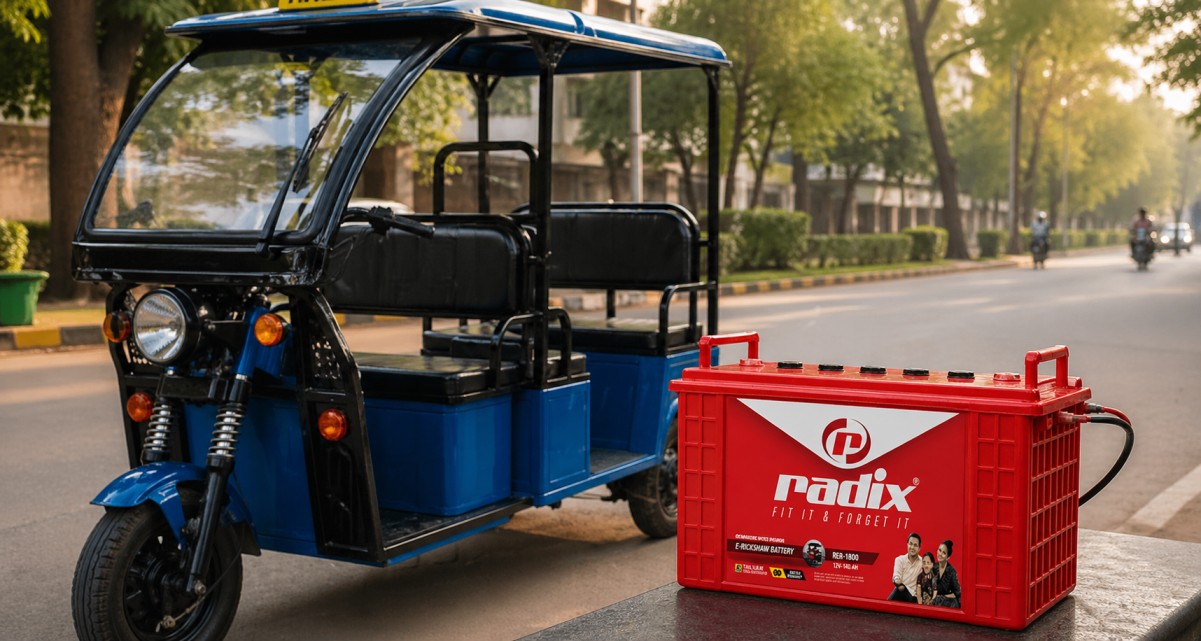
Radix Batteries, an E-Rickshaw Battery Manufacturer in India, offers different battery models for drivers and fleet owners who need practical mileage, steady power, and reliable daily performance. The range includes options for regular city use, longer running needs, and different budget levels.

Why Battery Quality Matters in an E-Rickshaw

E-rickshaws usually do not get easy working conditions.

They run in traffic, carry passengers, stop and start again and again, and often work for long hours. The battery has to handle this daily routine. A weak battery may work for some time, but soon the driver starts noticing the usual problems: lower mileage, slow pickup under load, frequent charging, and early replacement.

A good battery for e-rickshaw should support daily commercial use. It should give stable output, proper distance per charge, and dependable performance under regular load.

For drivers, this is simple. More backup means more running time. More running time means better earning chances.

Radix E-Rickshaw Battery Range

Radix offers multiple e-rickshaw battery models for different usage needs. All models are specifically designed for a 4-battery module setup, giving a 48V system commonly used in e-rickshaw applications.

ModelRatingPlate TypeBattery ModuleNominal EnergyMaximum DistanceCharging TimeWarrantyPacked Weight
RER-162512V 120AhFlat (+ve), Flat (-ve)4 Nos. / 48V1440 Watt85–95 km8–10 hrs6 months30 kg ± 0.5 kg
E HUMSAFAR 160012V 110AhTubular (+ve), Flat (-ve)4 Nos. / 48V1680 Watt100–110 km10–12 hrs6 months38.5 kg ± 0.5 kg
RER-170012V 120AhTubular (+ve), Flat (-ve)4 Nos. / 48V1680 Watt100–110 km10–12 hrs9 months38.5 kg ± 0.5 kg
RER-180012V 140AhTubular (+ve), Flat (-ve)4 Nos. / 48V1680 Watt100–110 km10–12 hrs12 months38.5 kg ± 0.5 kg

Which Radix Battery Fits Which User?

The Radix RER-1625 is a practical option for drivers who want a more economical battery for daily use. It comes with a 12V 120Ah rating and gives a maximum distance of around 85–95 km. Its 8–10 hour charging time makes it suitable for overnight charging.

The E HUMSAFAR 1600 is built for users who need better distance coverage. With tubular positive plates and flat negative plates, it is made for more regular commercial use. It gives around 100–110 km maximum distance and works well for drivers who want longer daily running.

The Radix RER-1700 gives a similar 100–110 km range but comes with a 12V 120Ah rating and 9-month warranty. This model fits drivers who want a stronger option than the basic range and better warranty support.

The Radix RER-1800 is the higher-capacity model in the range. With a 12V 140Ah rating and 12-month warranty, it is suitable for users who want better long-term value and stronger battery capacity for regular work.

What Makes Radix a Practical E-Rickshaw Battery Manufacturer in India?

A lot of buyers only ask about price. That is natural, but price alone does not decide whether the battery will perform well.

Mileage, charging time, plate type, weight, warranty, and daily usage pattern also matter.

Radix batteries are made with different model options so drivers can choose according to their actual work. Someone who runs shorter routes may not need the same model as a driver who works full day in busy city areas. A fleet owner may look more at durability and warranty. A single driver may focus more on cost and daily mileage.

This is where a proper E-Rickshaw Battery Manufacturer in India should offer options, not just one standard battery for everyone.

Common Problems Radix Batteries Help Address

One common issue in e-rickshaws is reduced mileage per charge. When the battery is weak or not suited for the vehicle load, the driver has to charge more often. This directly affects earning time.

Another issue is battery replacement cost. If the battery does not last properly, replacement becomes a regular expense. Radix offers models with warranty coverage from 6 months to 12 months, depending on the battery model.

Load handling is also important. E-rickshaws carry passengers, sometimes more than ideal, and move through uneven roads and traffic. A battery must provide steady energy output during this kind of daily work.

Charging time also matters. Most drivers prefer overnight charging because the vehicle is needed during the day. Radix batteries are designed with practical charging windows of 8–12 hours depending on the model.

For Drivers and Fleet Owners

For a single driver, the main concern is simple: the battery should run properly through the day and not create frequent trouble.

And for fleet owners, the concern is bigger. If multiple vehicles are standing because of battery problems, the loss becomes much higher. They need batteries that are easier to plan around, with clear model options, known mileage range, and practical warranty support.

Radix Batteries gives both types of users options — from RER-1625 for economical use to RER-1800 for higher capacity and longer warranty.

Final Thoughts

Choosing an e-rickshaw battery should not be done only by looking at price. The right choice depends on route length, daily running hours, passenger load, charging time, and expected mileage.

Radix Batteries, as an E-Rickshaw Battery Manufacturer in India, offers different battery models for different working needs. Whether the requirement is budget-friendly daily use, longer distance coverage, or higher capacity backup, Radix has options like RER-1625, E HUMSAFAR 1600, RER-1700, and RER-1800.

For e-rickshaw drivers, a dependable battery means fewer charging breaks and better running time. For fleet owners, it means smoother operations and less downtime.

That is what a good e-rickshaw battery should do — support daily work without becoming a daily problem.

6 Common Mistakes That Reduce E-Rickshaw Battery Life

An e-rickshaw battery is the heart of the vehicle. When it works well, daily income stays smooth. When it fails early, work stops and costs rise. Many drivers do not realize that small daily mistakes slowly damage the battery. In this blog by Radix, a trusted E-Rickshaw battery company in Meerut, we are going to understand the common mistakes that reduce E-rickshaw battery life.

Let us understand the common mistakes that reduce battery life and how you can avoid them.

1. Overcharging the battery

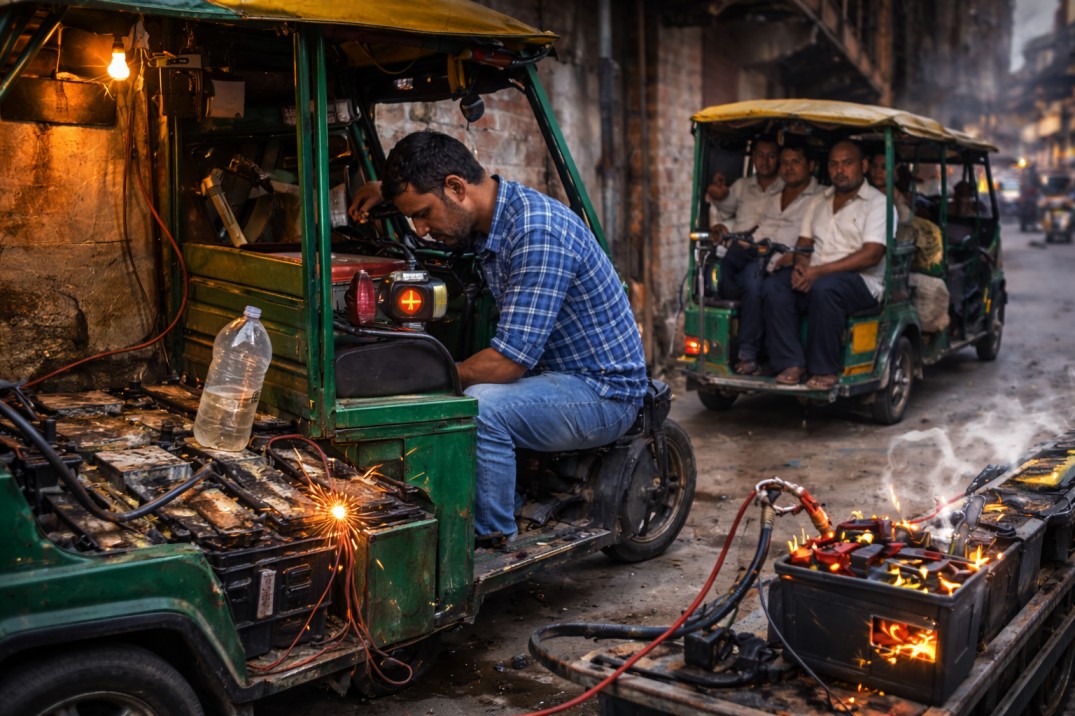
Many drivers leave the battery on charge all night. They feel more charging gives more backup. This is not true. Overcharging heats the battery. It damages the plates inside. Slowly, the battery stops holding charge like before. Always remove the charger once charging is complete. This small habit can add many months to battery life.

Radix batteries are made for daily use, but correct charging is still important. As a trusted E-Rickshaw battery company in Meerut, Radix guides drivers on safe charging every time.

2. Using the battery till it is fully empty

Some drivers keep driving until the battery is fully drained. This puts heavy pressure on the battery. It reduces life and can cause sudden stops on the road.

Recharge when the battery level comes down to around 20 to 30 percent. This keeps the battery healthy and power steady each day.

3. Forgetting water levels in lead acid batteries

Lead acid batteries need proper water levels. Many drivers forget to check this. Low water exposes the plates and causes damage. Using tap water also harms the battery.

Check water levels regularly. Use only distilled water. This simple step improves battery life and performance.

As an experienced E-Rickshaw battery company in Meerut, Radix always advises easy care steps to avoid early battery failure.

4. Overloading the e-rickshaw

Extra passengers or heavy loads put stress on the battery. The motor pulls more power. The battery drains faster and heats up. Backup reduces and life becomes shorter.

Always follow load limits. A balanced load keeps both battery and motor healthy.

5. Poor storage during off days

If the e-rickshaw is unused for many days, the battery should not be ignored as when left idle, it loses strength fast.Fully charge the battery before storage. Recharge it once every few weeks. This keeps the battery active and ready.

Radix batteries are built for Indian conditions, this is why many drivers trust Radix as their E-Rickshaw battery company in Meerut.

6. Using low quality chargers or loose wiring

Cheap chargers and loose wires cause uneven charging. This leads to heating and internal damage. Always use good quality chargers and check wiring often.

Why choose Radix e-rickshaw batteries

1.Built for long daily routes
2.Low maintenance and steady power
3.Made for Indian roads and weather
4.Trusted by drivers and dealers

Radix is counted among the best battery manufacturers in India because it focuses on real road use. Drivers choose Radix for fewer breakdowns and better daily earnings.

Final words

Most battery problems come from daily habits. Correct charging, proper load, and basic care can improve battery life a lot. The right battery brand also makes a big difference.

Radix continues to support drivers and partners as one of the best battery manufacturers in India. With the right care and a trusted battery, every route feels easier and more profitable.

Battery Capacity and Range: Key Considerations for E-Rickshaw Owners

E-rickshaws have become a popular mode of transportation in Uttar Pradesh (U.P.), offering a cost-effective alternative to traditional vehicles. As an E-Rickshaw battery company in U.P., Radix understands the importance of battery capacity and range for e-rickshaw owners to ensure optimal performance and longevity. In this blog, we’ll explore the key factors that influence battery capacity and range, helping e-rickshaw owners make informed decisions for their vehicles.

Understanding Battery Capacity and Range

Battery Capacity refers to how much energy a battery can store, measured in ampere-hours (Ah) or watt-hours (Wh). Range, on the other hand, indicates how far an e-rickshaw can travel on a fully charged battery. Together, these factors determine how reliable and efficient an e-rickshaw will be for daily use.

Importance of Battery Capacity

1. Long-Distance Travel: Higher battery capacity translates to longer travel distances on a single charge. For e-rickshaw owners in U.P., where distances can vary significantly, investing in a higher capacity battery is crucial for covering longer routes without frequent recharging.

2. Efficiency: Batteries with higher capacity provide better efficiency, ensuring that energy is utilized effectively. An E-Rickshaw battery company in U.P., like Radix, ensures that battery capacity meets the specific needs of local operators.

Factors Affecting Battery Capacity

1. Type of Battery: Different battery types, such as Lead-Acid, Lithium-ion, or newer advancements like Radix’s proprietary battery technologies, offer varying capacities and lifespans.

2. Vehicle Design: The design of the e-rickshaw influences how much energy is required for propulsion. A well-engineered vehicle ensures optimal use of battery capacity.

3. Usage and Maintenance: Regular maintenance, proper charging practices, and usage patterns significantly impact battery capacity over time.

Range Considerations

Range plays a vital role in determining how far an e-rickshaw can travel before needing a recharge. Factors like battery capacity, vehicle weight, terrain, and weather conditions affect range.

1. Battery Technology: Modern technologies employed by E-Rickshaw battery companies in U.P., such as Radix’s advanced lithium-ion batteries, offer enhanced range and durability, ensuring that e-rickshaws perform consistently over long distances.

2. Route and Load: Hilly terrains or heavy loads require batteries with higher capacities to sustain longer trips. Radix’s battery solutions are designed to meet such demanding conditions, making them ideal for U.P.’s diverse geography.

Radix’s Role in Enhancing Battery Performance

As an E-Rickshaw battery company in U.P., Radix takes pride in offering cutting-edge battery solutions that cater to the unique needs of e-rickshaw owners. Our commitment to innovation ensures that our batteries provide not only higher capacity but also longer ranges, resulting in superior performance and reliability. Through continuous research and development, Radix aims to enhance battery life and efficiency, contributing to the sustainability of the e-rickshaw industry in Uttar Pradesh. With Radix, e-rickshaw owners can enjoy seamless rides with minimal downtime and maximum profitability.

How to Choose the Right Battery for Your E-Rickshaw

Choosing the right battery for your E-rickshaw is a crucial decision that directly impacts the vehicle’s performance, lifespan, and overall efficiency. The battery powers the motor and determines the distance your E-rickshaw can travel on a single charge. As the demand for electric rickshaws continues to rise, selecting the right battery from a reputable E-rickshaw battery manufacturer is essential for ensuring reliable performance. This decision requires a careful evaluation of various factors such as battery type, capacity, lifespan, and cost.

 1. Battery Types: Lead-Acid vs. Lithium-Ion

When selecting a battery, it’s important to understand the different types available on the market. The most common types of batteries used in E-rickshaws are Lead Acid Batteries and Lithium-Ion Batteries. Lead-acid batteries are more affordable but have a shorter lifespan and require regular maintenance. On the other hand, lithium-ion batteries are more expensive upfront but offer greater efficiency, a longer lifespan, and require minimal maintenance. These batteries are increasingly being favored by E-rickshaw owners due to their improved performance and longevity, making them a top choice from most E-rickshaw battery manufacturers.

 2. Battery Capacity and Voltage

In addition to battery type, other factors such as battery capacity, voltage, range, and charging time must be considered. Battery capacity determines the range of your E-rickshaw, while voltage affects its speed and acceleration. It’s essential to choose a battery that matches your E-rickshaw’s requirements based on the distance you need to travel and how quickly you need it to recharge. The best E-rickshaw battery manufacturers can guide you through the selection process to ensure you get the right fit for your vehicle’s needs.

 3. Durability and Maintenance Needs

When it comes to durability, the lifespan of the battery is another crucial consideration. Lead-acid batteries generally last between 1-2 years, while lithium-ion batteries last much longer—typically 5-7 years. While lead-acid batteries are cheaper initially, their shorter lifespan and regular maintenance needs make lithium-ion batteries a more cost-effective investment over time. Choosing the right battery means balancing your initial budget with long-term operational costs and maintenance.

 4. Choosing a Reputable E-Rickshaw Battery Manufacturer

When purchasing a battery for your E-rickshaw, it’s essential to choose a reputable E-rickshaw battery manufacturer. Trusted manufacturers offer batteries that meet safety standards and come with warranties, ensuring peace of mind for the buyer. Additionally, top manufacturers provide after-sales support, which is crucial for ongoing maintenance and service. Be sure to research the reputation of the manufacturer, read reviews, and seek recommendations from fellow E-rickshaw owners.

 Conclusion

In conclusion, selecting the right battery for your E-rickshaw is a decision that impacts both your short-term experience and long-term costs. Whether you choose a lead-acid or lithium-ion battery, make sure to assess factors like battery capacity, range, and lifespan. By purchasing from a reliable E-rickshaw battery manufacturer, you ensure that your vehicle operates efficiently and effectively, ultimately providing you with the best value for your investment.

Choose Radix E-Rickshaw Batteries for unmatched performance and longer lifespan. Whether you’re looking for reliable lead-acid or cutting-edge lithium-ion options, we’ve got you covered. Upgrade your ride today with a battery designed for efficiency and durability.