
The Morning Shift Is Fine. Why Does An E-Rickshaw Feel Weak By Evening?

The e-rickshaw may seem to be fast and responsive in the morning, but it can be slow in the evening. It is not necessarily because of any problem with the battery. Most often, it is due to the fact that the battery has depleted a significant amount of energy after long hours of carrying passengers, traveling through traffic, accelerating, and adapting to different road surfaces. The E-Rickshaw Battery Manufacturer India should consider all these aspects and not just focus on the battery specifications.

For drivers, there is one straightforward question that needs an answer: “What is different from the morning drive to the evening drive?”

The Battery Starts The Day With More Energy

At the beginning of the day, the battery is typically charged to a relatively higher level. This ensures that there is sufficient power for accelerating, going up slopes, and accommodating passengers.

With each journey during the course of the day, there is usage of some of the energy stored in the battery. By the end of the day, although the battery might be able to support the vehicle movement, the amount of energy left is lower than when the work shift began.

This explains the variation in performance despite no immediate issue with the battery.

An E-Rickshaw Battery Manufacturer in India should point out the factors involved.

Passenger Weight Changes Energy Use

An empty and a loaded e-rickshaw do not put in the same demand on the motor.

More people on board means the motor has to work harder, especially when pulling away from rest or climbing up a hill. This extra effort over a period of time will drain the battery.

Suppose two drivers have similar e Rickshaws. One driver normally carries one or two passengers while the second driver always carries people in full numbers. Both have the same battery fitted in their e Rickshaws. The first driver covers more distance on a single charge than the second driver on a daily basis. Now, who has a better battery?

Stop-Start Traffic Uses More Energy

City driving can be slow, with frequent stops and starts.

Every time the vehicle is accelerated from a standing start, more power is demanded from the motor than when running at a constant speed. In heavy traffic, this can happen hundreds of times in a single journey.

It is a particular problem in busy markets and on short runs in the city, as is the case with many drivers in Meerut and other towns in Uttar Pradesh.

An E-Rickshaw Battery Company in Meerut that supplies batteries to local drivers should be aware that a battery that performs well in controlled conditions may find itself in very tough conditions in the real world.

Route Changes Can Affect The Evening Shift

Drivers seldomly repeat the same route throughout the day.

There might be short, low-intensity drives in the morning, followed by driving in more traffic, longer routes, or rougher roads later on.

These factors can increase the energy consumption of the vehicle.

Tyre pressure also plays an important role in the rolling resistance, which means that the motor needs to work harder and expend more energy when the pressure is low.

A drop in performance in the evening, therefore, should be evaluated with the whole route and state of the vehicle in mind.

Partial Charging Can Make The Next Shift Harder

Some drivers charge the vehicle for a short period of time between trips or during their lunch.

That extra charge can make all the difference, but a quick charge might not have enough time to replace all of the lost energy.

If the battery starts out the afternoon only partially charged, the evening shift will have less energy than the morning one. This becomes an even bigger issue if the pattern repeats itself over multiple days.

A responsible E-Rickshaw Battery Manufacturer in India would consider both how much the vehicle was driven and how much it was charged back up during the day.

The important question isn’t just “how much did the vehicle drive?”

but also “how much energy did the battery regain before being driven again?”

Driving Style Also Matters

Fast acceleration can drain more energy than slow acceleration.

Drivers who are racing against the clock may find themselves accelerating rapidly, braking, and accelerating again and again throughout the day.

A gentler approach to driving can conserve energy by using the battery more efficiently

and

taking away some of the wear and tear on the car’s systems.

It doesn’t mean that the driver has to be especially slow, only that they give the car a gentle kick rather than flooring it at every opportunity.

When Should The Battery Be Checked?

Some degree of evening sluggishness is to be expected as the battery discharges. However, if there is a sudden or significant change this should be investigated

Check the system if:

  • The range is falling away sharply compared with previous days
  • It is taking significantly longer to charge
  • The battery is not reaching its normal fully charged voltage
  • The vehicle is feeling sluggish even at the start of the day
  • The charger is reporting multiple errors
  • Connections are hot or loose

The problem could be with the battery, the charger, the wiring, the motor, the controller, the tyres, or the vehicle load. This is why diagnosis should always precede replacement.

Radix And Real E-Rickshaw Usage

The process of selecting batteries for e-rickshaws at Radix always considers the manner in which the vehicle operates.

The distance driven per day, the number of passengers, the time needed for recharging, and the traffic conditions are all variables.

As an E-Rickshaw Battery Manufacturer in India, we understand that the former is dependent on the conditions of the driver.

For an E-Rickshaw Battery Company in Meerut, understanding the conditions a driver operates in can be the most effective means of choosing an appropriate battery. A driver who operates in highly populated areas may have different requirements from a driver who operates under shorter distances and with fewer passengers.

Final Thoughts

An e-rickshaw may perform better on a daily basis since the battery is fully charged at the start of the day.

By the evening, the weight of the passengers, traffic, acceleration, detours, and limited opportunity to charge the battery may combine to reduce the range.

Before concluding that the battery is faulty, evaluate the cumulative effect of factors over an entire day.

The more consistent the battery performance is with the routes driven and the work patterns of the driver, the more predictable the range will be on a day-to-day basis.

Frequently Asked Questions

1. Why Does My E-Rickshaw Feel Slower In The Evening?

The battery has already used part of its stored energy. Heavy loads, traffic, repeated acceleration, and long routes can also increase energy use.

2. Does Passenger Weight Affect E-Rickshaw Battery Range?

Yes. A heavier vehicle needs more energy, especially during acceleration and uphill travel.

3. Can Traffic Reduce E-Rickshaw Range?

Yes. Frequent stopping and restarting can use more energy than steady-speed driving.

4. Does Partial Charging Help During The Day?

It can add useful energy, but a short charge may not fully restore what the battery used earlier.

5. When Should An E-Rickshaw Battery Be Checked?

Get it checked if range drops suddenly, charging changes, the vehicle feels weak from the morning, or the charger shows repeated problems.

6. Why Choose Radix As An E-Rickshaw Battery Manufacturer In India?

Radix focuses on matching battery solutions with real driving needs, including daily distance, passenger load, charging time, route, and local operating conditions.
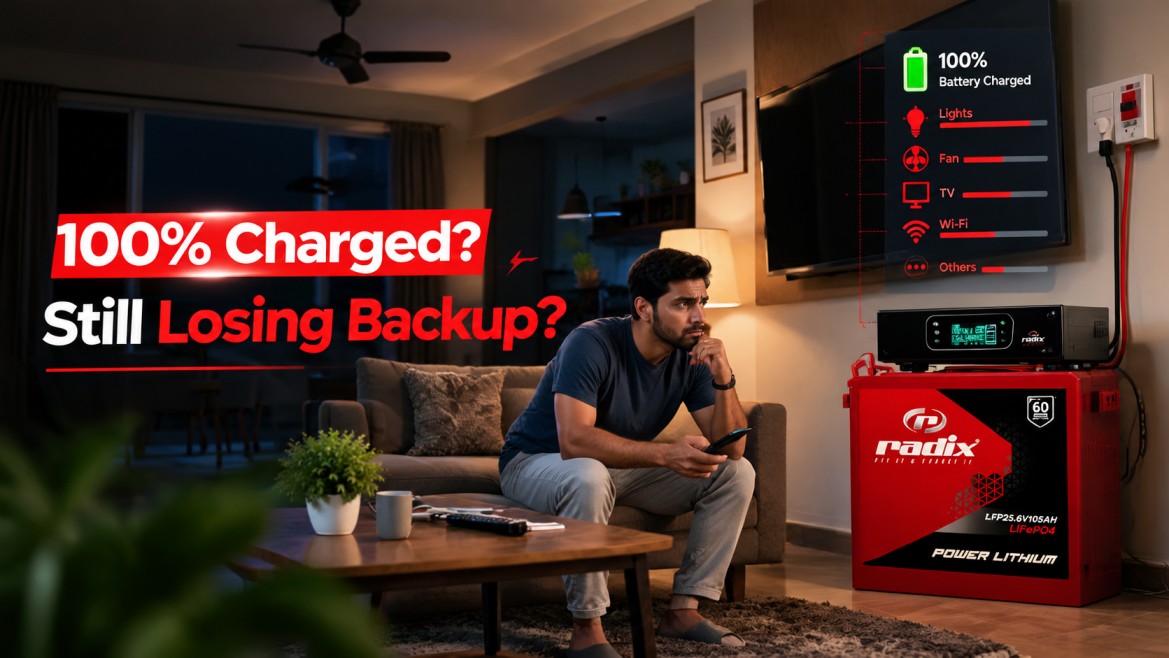
Your Inverter Battery Is Fully Charged. So Why Does Backup Still Drop Fast?

A battery may indicate a full charge, but it may offer lesser backup than expected. This does not necessarily mean that the charging indicator is faulty or the battery has failed all of a sudden. An experienced Inverter Battery Manufacturer in India would investigate the load, battery’s age, connections, inverter’s condition, and the pattern of the power-cut before concluding an issue.

In short, the full battery indicator only states the charge level of the battery; it does not indicate how fast your home will consume the electricity

Why A Full Charge Does Not Guarantee Long Backup

Battery backup depends on two factors; the amount of energy the battery can deliver and the rate at which the connected appliances consume.

Take for instance, a house that used to have two fans, three lights, and a Wi-Fi router hooked onto an inverter. As time goes, the owners buy a bigger television, CCTV cameras, laptops, more lights, and several phone chargers. The battery may reach the usual full mark, but the rate of energy consumption has increased, thereby draining the power faster than before.

This is one of the first problems an Inverter Battery Manufacturer in India will address if a customer complains of inadequate backup.

Before rushing to the battery’s assumption, cross-check the consumption load with what was connected to the inverter during installation.

Your Home Load May Be Higher Than You Think

Many appliances seem to be small when considered individually

A Wi-Fi router, CCTV, television, laptop, set-top box, and mobile chargers might not seem like much. However, when combined with a few fans and lights, the power they consume altogether can be pretty significant.

Hence, two homes using the same battery may have vastly different backups.

One family might be able to turn off a lot of high-drain appliances when the backup starts depleting, while the other might not. Obviously, the latter would have a faster-draining battery.

A good Inverter Battery Manufacturer UP would advise users based on their essential appliances and not the idea of having everything running.

Battery Age Changes Usable Capacity

A battery is not new forever.

As it goes through charge and discharge cycles, the ability to store power is changed. Even if the battery is fully charged, its capacity may be lower than on the first day.

Thus, if the battery has a certain amount of age on it, even if it reaches the charging limit, its capacity reserve may be lower than expected.

Other symptoms may also be present:

  • Backup time decreases progressively over a period of months
  • Charging occurs more rapidly than before
  • Low battery warnings occur at higher charge levels
  • There is increased sensitivity to heavy loads

The battery’s age should not be the sole determining factor for replacement, but should be taken into account with its backup, charge characteristics and physical condition.

Wiring Loss Can Quietly Reduce Backup

Sometimes the battery is good, but the power goes somewhere else.

Loose terminals, corroded connections, small cables or poor joints can lead to higher resistance in the circuit, resulting in voltage drops, heating or inefficient power delivery.

The system may still be functional, so it’s easy to overlook.

Before replacing a battery, check:

  • Battery terminals
  • Cable tightness
  • Cable size
  • Corrosion signs
  • Heating near connections
  • Inverter connections

An Inverter Battery Manufacturer in Meerut catering to residential and dealer customers in the region should always consider installation quality when diagnosing low backup issues.

A good battery will not compensate for a poor electrical connection.

The Inverter Also Uses Energy

The inverter is not 100% efficient.

While the power stored as DC current in the battery is converted to AC current for use by home appliances.

Some power is lost in the process.

The extent of loss depends on several factors like inverter design, load and others.

Also, an old or inappropriate inverter can have a negative impact on the ability of the battery to charge and discharge.

Thus, if the inverter is not operating at optimal load, one could be in for a sobering surprise when it comes to the backup provided by the inverter-battery combination.

That is why it is important to think of the battery and inverter as a system.

A responsible Inverter Battery Manufacturer in India will advise you on the appropriate pairing based on battery Ah, inverter capacity, the load that is likely to be connected and the desired back up.

Your Backup Expectation May Have Changed

Sometimes there is not a technical problem.

The demand may have changed.

A family once used to be happy with three hours of fans and lights, but now they want Wi-Fi, CCTV, television, laptops and other appliances to remain on as well.

The battery is being asked to do more than it used to.

It can make longer power cuts seem like the same thing. A short circuit system may seem insufficient if local outages begin to last two or three hours.

For users in Uttar Pradesh and cities such as Meerut, actual outage number and local use should be factored into battery planning. This is where working with Inverter Battery Manufacturer UP helps match the battery to real operating conditions and not a general capacity chart.

What Should You Check Before Replacing The Battery?

If, despite a fully charged battery, your backup fails you, the remedy does not necessarily lie in replacing the battery

First explore the entire setup

Ascertain that the load has not risen beyond the rated capacity. Check wiring and terminals, the age of your battery, if the inverter is charging the battery and most importantly, compare the load to which the inverter was subjected to with the power cut it was designed to overcome.

At Radix, we believe in going beyond the battery to determine an accurate solution for your backup woes. As an Inverter Battery Manufacturer in India, we have to consider more than just the battery to ensure that your backup works for you. Load, battery condition, charging, installation and usage patterns are all factored in

efore a solution is proposed. This way, we can ensure that your backup power source is not being undersized for your needs.

Final Thoughts

A fully charged battery might not give you as long of a backup as you expect, since full charge + available backup is not equal.

The higher the load, the more effect battery ageing, wiring loss, inverter efficiency, and longer mains outages will have on available backup time.

Before buying a bigger battery, find the cause of the reduced backup.

The solution may be a bigger battery, but might also include load management, wiring repair, inverter check, or better system sizing.

Frequently Asked Questions

1. Why Does My Fully Charged Inverter Battery Drain Quickly?

The connected load may be high, the battery may have lost usable capacity, or the wiring and inverter may be reducing system efficiency.

2. Does A Full Battery Always Mean Maximum Backup?

No. Full charge only shows the starting charge level. Actual backup depends on battery condition, load, inverter efficiency, and usage.

3. Can Old Wiring Reduce Inverter Battery Backup?

Yes. Loose or corroded connections can create voltage drop and power loss, which may reduce the backup you experience.

4. Should I Buy A Bigger Battery If Backup Is Low?

Not immediately. First check the load, battery health, inverter support, charging system, and wiring. A bigger battery will not fix every problem.

5. Why Choose An Inverter Battery Manufacturer In Meerut?

A local manufacturer or dealer can better understand regional power-cut patterns, usage conditions, service needs, and common inverter applications.

6. How Does Radix Help With Inverter Battery Selection?

Radix considers load, required backup time, inverter compatibility, charging conditions, installation, and real power-use patterns before recommending a suitable battery solution.