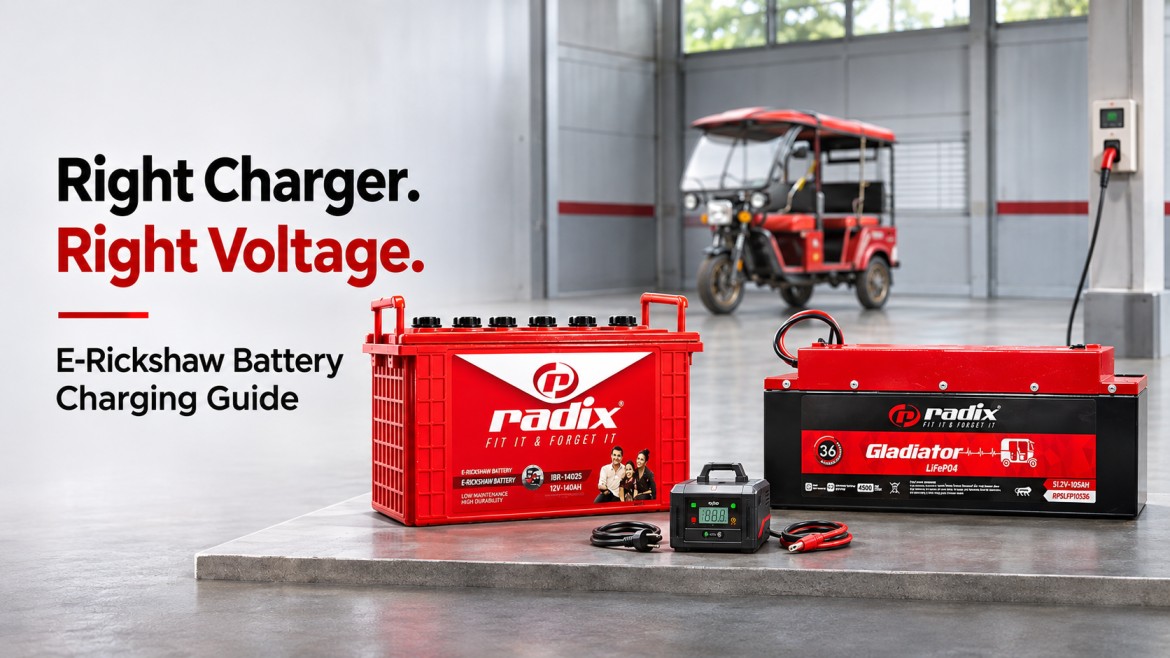
The battery of your e-rickshaw isn’t working as efficiently as it once was. The charging process takes much longer and sometimes the charge will stop mid-charge. This could be because your charger and battery bank aren’t compatible with each other. Talk to a trusted E-Rickshaw Battery Manufacturer in India so you can find out what the correct charging voltage, current and chemistry for your battery should be. This will ensure safe charging, reliable operation and long term performance.
Why Is Charger Compatibility Important?
The e-rickshaw battery charger will convert the AC power into regulated DC power.
However, the charger must be compatible with your battery. The correct output will depend on your battery banks voltage, chemistry and also what the manufacturer recommends. The incorrect charger can cause undercharging, overheating and damage to the battery. It is important to ensure that it is compatible.
Understanding 48V and 60V E-Rickshaw Battery Banks
Many e-rickshaws will use either a 48 or 60V nominal battery pack.
This is usually made up of 4x 12V Lead acid batteries in series connection. 60V packs can sometimes be 5 12V batteries.
Nominal Voltage Vs Charging Voltage
The rated voltage of the battery refers to the nominal voltage that the batteries operate at. This does not mean they have a full charge at this voltage.
For example, 4x 12V lead acid batteries will give a nominal voltage of 48V.
When charging a higher controlled voltage will be required by the charging unit. This will depend on the manufacturer’s specs.
The voltage will vary depending on the battery design, charging phase and temperature.
Never go based on nominal voltages when choosing a charger.
How to Match Charger Output With Battery Voltage
Check the nominal voltage and chemistry of your battery bank Then check what charge voltage and max charge current the manufacturer recommends. Compare with the charger you are using.
If you have a 48v Lead Acid bank, a charger for that won’t work automatically on a 60v bank Lead acid chargers may not be compatible with lithium batteries. Even if they have the same nominal voltages.
Does Charging Current Affect Battery Performance?
This is the rate of charge applied to the battery. If too high of a charge rate is applied by the charger then excess heat can occur and cause the battery to degrade faster.
If the charge rate is too low you can expect to see a much longer recharge time.
Example:
Let’s say we have a 100Ah battery bank.
With a 10A rated charger it should take us 10 hours to fully charge the battery. However in practise this will take longer due to the charge rate changing throughout the charge cycle and battery efficiency.
Always follow the manufacturers recommended charge rates.
Lead-Acid vs Lithium E-Rickshaw Charging
Lead acid batteries normally go through bulk, absorption and float charging.
Lithium batteries require charging profiles that match their cell chemistry and BMS.
The BMS will also monitor the voltage, current and temperature of the lithium battery and cut off charging if it is unsafe. However, the BMS shouldn’t be used as a replacement for using the correct charger.
When choosing an E-Rickshaw Battery Manufacturer in India, you need to know if they recommend using a charger that will work with your specific battery model and protection needs.
Common Signs of Charger Mismatch
Excessive delays in charging, shutting down of the charger, and overheating of the plug could be an indicator of a compatibility issue or an electrical problem. Other reasons might be faulty cables, incorrect polarity, aging batteries, and electrical issues.
If the charger gets excessively hot, emits strange odors, or shows errors all the time, cease its use and get it checked professionally. Do not tamper with any protective circuitry or charging plugs.
Choosing Radix E-Rickshaw Battery Solutions
Radix Power Solutions provides batteries for e-rickshaws, including Lead Acid & Lithium batteries.
The product range from Radix Power Solutions meets the various needs of electric mobility.
Prior to battery selection, ensure that you have confirmed its voltage, capacity, charging parameters, and vehicle compatibility.
Check out Radix E-Rickshaw Lithium Batteries and get the approved charging parameters of your selected battery model.
Frequently Asked Questions
1. Can I Use a 60V Charger With a 48V Battery Bank?
No, unless the battery manufacturer explicitly approves that charger configuration. Incorrect charging voltage can damage the battery.
2. What Charger Is Suitable for a 48V E-Rickshaw Battery?
Choose a charger approved for the battery’s chemistry, nominal voltage, required full-charge voltage and charging-current limits.
3. Does a Higher Ampere Charger Charge Faster?
It may reduce charging time, but only when its output current remains within the battery manufacturer’s permitted limits.
4. Can a Lead-Acid Charger Charge a Lithium E-Rickshaw Battery?
Do not assume compatibility. Lithium batteries require chemistry-specific charging settings and suitable BMS integration.
5. Why Does My E-Rickshaw Charger Stop Before Full Charge?
Possible reasons include incorrect charger settings, battery protection activation, overheating, faulty connections or battery deterioration.
6. How Do I Choose an E-Rickshaw Battery Manufacturer in India?
Compare battery specifications, compatible charger recommendations, warranty terms, technical documentation and available after-sales support.
Conclusion
Matching charger output to battery bank voltage is key for reliable operation of your electric rickshaw. Choosing a suitable charger will ensure that it is compatible with the battery chemistry, charging voltage and current.
When choosing an E-Rickshaw Battery Manufacturer in India choose one that has suitable technical specifications.
Visit Radix Power Solutions to find out what e-rickshaw batteries we have available and to discuss charging requirements.